Let's Get That Pending Article Published To The World
For Adverts and Enquiries
Phone: 234 903 352 3975
Email: triplenetblogs@gmail.com

Let's Get That Pending Article Published To The World
For Adverts and Enquiries
Phone: 234 903 352 3975
Email: triplenetblogs@gmail.com





Capital Market Solicitors harp on adequate funding of Health Sector to boost development
By Elizabeth
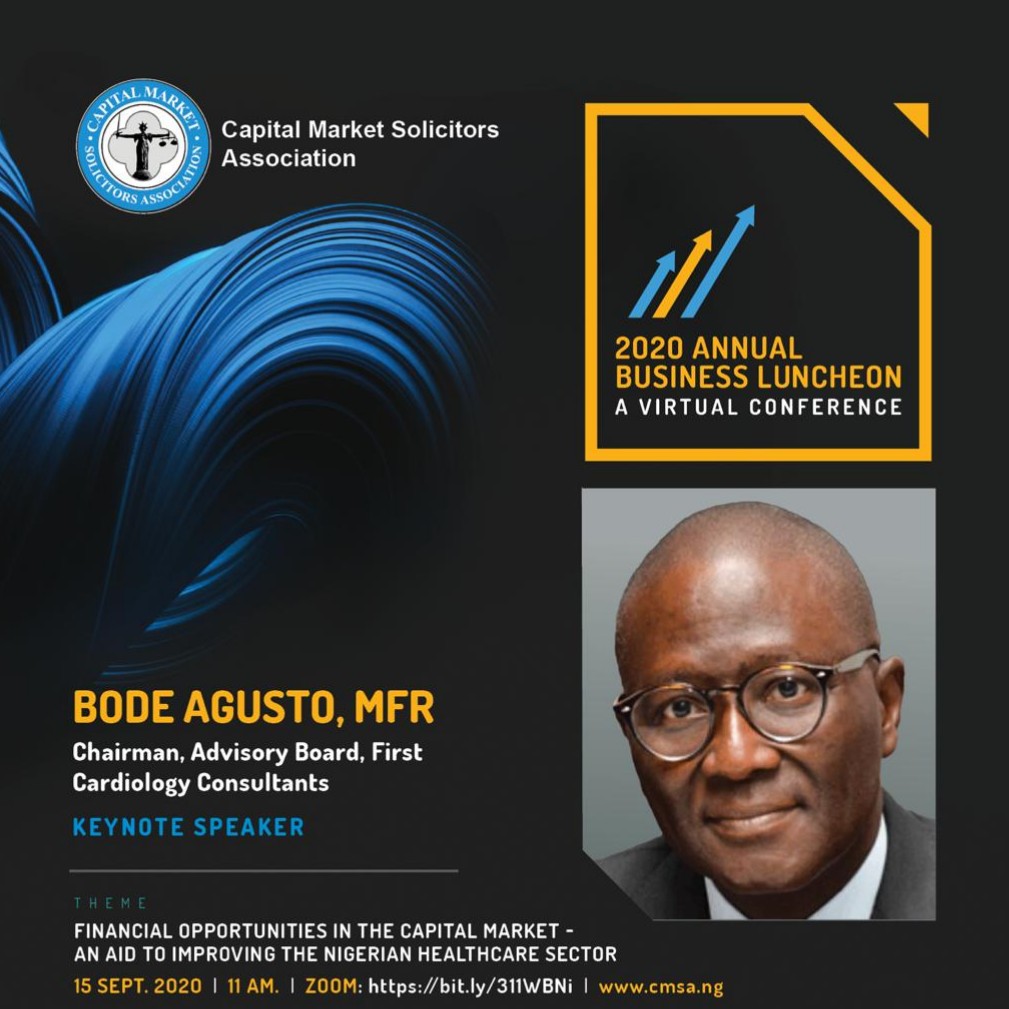
In the wake of activities and phenomena marking recent times, top on the list of which is the Covid-19 pandemic, which has left nations of the world in utter dismay, and causing a major drawback in both the financial, economical, educational, and even the socio-economic speheres of life, The CAPITAL MARKET SOLICITORS ASSOCIATION (CMSA) deemed it necessary to take a leap into viable ways of enhacing the health sector of the economy, to keep it in tune with international standards and best practices.
The Conference hosted virtually by the CMSA is themed, “Financial Opportunities in the Capital Markets – An Aid to Improving the Nigerian Healthcare Sector”
it is aimed at broadening the perspectives of the Nigerian healthcare sector through discussions on access to the financial opportunities in the capital market.
Tackling the Topic, Mr. Olabode Agusto, Founding Managing Director of Agusto & Co., and Chairman of the Advisory Board of First Cardiology Consultants, enumerated who the key stakeholders in the healthcare sector are.
He said that they include: Patients, Service providers, (Doctors, Nurses, Other clinical staff, Nonclinical staff, Pharmaceutical companies, and Other Investors) Payers (Insurance companies, Government, Individuals, philanthropists)
According to him, Patients want quality care at competitive prices and ready access to their medical records, adding that Payers also want value for money and opportunities to invest their surplus funds in an environment where prices are fairly determined.
"Service providers who are employees want professionally and financially rewarding careers, whilst those who are investors want timely payment for services and competitive returns on their investments.
"Government as regulator, wants products and services that perform and fair trading in the industry.
"As a person who cares for its citizens, Government wants access for the poor and weak in society and cares about future healthcare concerns and how to plan for them," he said
Augusto said that China's average income per person is five times that of Nigeria, adding that Were Nigeria to spend at China's level after adjusting for income levels, she should be spending about US$200 per person per year.
" This means US$40billion per year or about 9% of nominal GDP; It also means spending NGN16 trillion per year, at current exchange rates, or almost two times the total amount shared by the Federation Account in 2019!" he said
He proffered a way forward and said;
"Therefore, Government alone cannot fund this. How then do we then finance this level of healthcare spending?
"In substance, only two groups of people are the ultimate payers for healthcare; they are individuals and employers.
"Under one model,they pay taxes to governments which these governments use to provide healthcare services to the citizens.
"Under a second model, individuals and employers pay for health insurance and these insurance companies pay for healthcare from premiums received.
"I have not seen anywhere in the World where the third model of paying out of pocket has delivered a good healthcare system.
"However, all these mean that there is no free healthcare anywhere. It could be free at the point of receiving the service, but someone, somewhere is paying for it.
"I believe that Nigeria should fund healthcare through a universal health insurance system; Under this system, health insurance should be made obligatory for all Nigerians. Workers will pay their premiums largely through employer sponsored programs, self-employed people will buy their own insurance while Government will then assist the poor and weak in society to buy insurance.
"The premiums paid to health insurance companies thus create a large pool of savings to pay for healthcare" he said
On the role of the capital markets in ensuring that we are able to pay for healthcare, he said
"In my opinion, the biggest risk that the pool of savings will face is inflation risk. This is because the long-term rate of intlation on the Nigerian Naira is about 12% per annum.
"This means that savings held in NGN and debts that will be repaid in fixed Naira terms will lose purchasing power at about 12% per annum. It also means that the returns earned from investing the pool of savings (net of costs) must be at least 12% per annum to protect the buying power of the savings.
"Finally, premiums must also be adjusted at least annually to reflect the purchasing power of the NGN". he said





 81
81
©www.triplenet.com.ng/lawparliament
All right Reserved